Packages & Pricing
Transparent pricing. Every dollar accounted for.
Transparent pricing. Every dollar accounted for.
All packages include professional guides, porters, meals, camping equipment, park fees, airport transfers, hotel accommodation before and after the climb, emergency oxygen, and a summit certificate. The main decision is acclimatization time: Basecamp keeps the classic 7-day Machame pace, Summit adds a safer 8-day Lemosho profile, and Peak gives the most time on the mountain.
2026 climbing season filling fast: secure your dates
BASECAMP
Your First Summit
Best for strong hikers who want the classic 7-day Machame route and are comfortable with a busier trail.
SUMMIT
The Complete Experience
Best for most first-time climbers. The extra day improves acclimatization and gives you a more scenic Lemosho approach.
PEAK
The Ultimate Journey
Best for climbers who want maximum acclimatization, fewer crowds, and the most complete traverse around the mountain.
7 days, Machame Route
Great for most climbers. The classic Kilimanjaro experience with the iconic Barranco Wall scramble.
8 days, Lemosho Route
Extra acclimatization day = higher success rate (98% vs 95%). Quieter, more scenic trail. Worth it if you have the extra day.
Not sure? Most climbers choose SUMMIT for the extra acclimatization day.
9 days, Northern Circuit
Ultimate experience for those who want the most remote route with a full 360° traverse, nine days for acclimatization, and a 97% success rate.
Still deciding? We're happy to help.
Call (647) 930-4482 or WhatsApp us: we respond within 1 hour
Kilimanjaro is not technically difficult, but altitude is the real filter. If you are unsure, choose the route with more time on the mountain. For most first-time climbers, that means Summit on 8-day Lemosho. If your schedule is tight and you already hike regularly, Basecamp can still make sense. If you want the highest margin and quietest route, choose Peak.
Ask Which Route Fits YouNo hidden fees. No markups on essentials. See exactly where every dollar goes.
$2,450 in direct costs → $800 operating margin
That's a 25% margin. Most operators take 40-60%. Fair to you, sustainable for us, and it lets us pay our crew properly.
Same mountain. Same summit. Half the price.
Kilimanjaro quotes can differ by thousands of dollars for what looks like the same climb. Before you choose anyone, put every quote through this checklist.
Are all park fees included? Conservation, camping, and rescue fees are the largest single cost of any climb. Budget operators sometimes quote without them and add them at the gate. Ask for the all in figure in writing.
Who treats the crew well? Ask whether the operator runs its own crews or brokers them out, and whether porters are paid fair wages and carry proper gear. Operators certified by the Kilimanjaro Porters Assistance Project (KPAP) submit to independent checks. We run our own vetted, KPAP-certified mountain crews and publish the wage structure in the tipping section above.
What safety equipment and protocols are standard? Emergency oxygen, twice daily health checks, and a clear descent policy should be included, not upsold. Ask any operator exactly what happens, step by step, if you develop altitude sickness at 4,500 meters. Vague answers tell you everything.
What happens before and after the mountain? Airport transfers, a hotel night before the climb for your briefing, and a hotel night after are meaningful logistics that cheaper quotes quietly drop, leaving you to arrange and pay for them yourself on arrival.
How many days does the itinerary actually give you? Compare like with like: a 6 day quote is not the same product as an 8 day quote, even on the same route. The extra days are acclimatization, and acclimatization is what you are buying.
Run the comparison, then read our how to choose an operator guide, which covers the red flags in more depth. Our own numbers sit on this page because we believe the transparent version wins the comparison.
We're upfront about tips because they matter to our crew.
Unlike other operators, our crew already earns fair base wages:
For a typical 7-day climb with 1 lead guide, 1 assistant guide, 1 cook, and 4 porters.
We provide tipping envelopes and a guide on how much to give. Bring USD cash in small bills.
One price, everything on this list. No operator fees added at the gate, no surprises on arrival day.
Conservation, camping, and rescue fees paid to Kilimanjaro National Park are built into your price. This is the largest single cost of any climb, and it is already covered.
A lead guide and assistant guides who know the mountain season by season, monitor your health twice daily, and make the safety calls without hesitation.
Your porters carry the camp equipment and your duffel, and your cook prepares fresh hot meals every day on the mountain. All are part of our own vetted, KPAP-certified mountain crews in Tanzania.
Breakfast, lunch, dinner, and snacks from day one to your last day on the mountain, with drinking water included. Dietary needs accommodated with notice.
Tents, sleeping mats, and a mess tent are provided and carried. You bring your own sleeping bag, or rent one locally.
Pickup at Kilimanjaro International Airport on arrival and return transfer after your climb, timed to your flights.
A hotel night before the climb for your briefing and gear check, and a night after you come off the mountain, with a real shower and a proper meal.
Every climb carries emergency oxygen and a medical kit, and your guides are trained to use them. This is standard equipment on our mountain, not an add on.
The official Kilimanjaro summit certificate, issued by the national park, is included for every climber who reaches Uhuru Peak.
We would rather you budget properly than feel surprised. These five items are on you, on every Kilimanjaro climb with any operator.
Travel insurance is mandatory for climbing with us, and it must cover trekking to 6,000 meters. We say this for your protection: evacuation and medical care in Tanzania are excellent but expensive without coverage. Our travel insurance guide explains exactly what your policy needs.
The honest version of the decision, including who should skip each one.
BASECAMP runs the classic Machame route over 7 days. It suits climbers who hike regularly, handle steep days well, and want the iconic itinerary with the Barranco Wall at the lowest of our three price points.
Skip it if this is your first big mountain, if you have any doubt about your fitness, or if your schedule can stretch to 8 days. The extra acclimatization day on SUMMIT is worth more than any gear you could buy.
SUMMIT is our 8 day Lemosho itinerary and our most popular package for a reason. The Lemosho approach is the most scenic way onto the mountain, the extra day builds real acclimatization, and the package holds a 98% summit success rate. For most first time climbers, this is the right answer.
Skip it only if your dates are genuinely fixed at one week, or if solitude matters more to you than anything else and you can take nine days, in which case look at PEAK.
PEAK follows the Northern Circuit over 9 days: the longest route, the fewest climbers, the deepest acclimatization, and a full traverse around the mountain that very few visitors ever see. It is the most complete Kilimanjaro experience we offer.
Skip it if your budget is tight or your time is short. The mountain is not more summable from the north; you are paying for wilderness, time, and margin.
Every package runs two ways.
Fixed start dates with climbers of mixed backgrounds, led by our full crew. There is no single supplement on group departures: solo travelers pay the package price and share camp logistics. Most climbers join groups, and many leave with friends for life. See our group tours vs private climbs guide for the full comparison.
Any package can run privately for your own party: your dates, your pace, your guides, no strangers. The private climb surcharge is $200 per person on top of the package price. Private climbs suit couples, families, training groups, and anyone who wants to set their own rhythm.
Simple terms, published up front.
Deposit: 25% of the package price secures your dates. The remaining balance is due 60 days before the climb. That is the entire payment structure.
Best seasons: the prime climbing windows are January to mid-March and June to October. July and August are the busiest months of the year, and the best dates in those weeks go first. If your schedule allows it, the shoulder months inside those windows give you quieter trails with conditions nearly as good.
How far ahead to book: early enough to hold your preferred dates and give yourself real training time. Our when to book guide gives the practical timeline by season, and our best time to climb guide breaks the weather down month by month.
If you are unsure: book the dates you can actually train for. A confirmed climb with a proper preparation block beats a bigger plan you keep postponing. We will also tell you honestly if a date you want is a poor fit; read our rainy season guide before you commit to April, May, or November.
The questions we hear most, answered straight.
Our packages run from $2,950 to $4,400 per person: BASECAMP is $2,950 for the 7 day Machame route, SUMMIT is $3,250 for the 8 day Lemosho route, and PEAK is $4,400 for the 9 day Northern Circuit. Every price includes park fees, guides, porters, cook, all mountain meals, camping equipment, airport transfers, hotel nights before and after, emergency oxygen, and your summit certificate. Private climbs add $200 per person.
Five things: international flights, your Tanzania visa ($50-100 depending on nationality), travel insurance, which is required and must cover high altitude trekking, personal gear, and crew tips of $250-350 for a typical climb. Everything on the mountain itself is covered.
A 25% deposit secures your dates, and the balance is due 60 days before the climb. There are no other fees. Once you are booked, we send your preparation timeline, gear list, and briefing schedule.
SUMMIT, our 8 day Lemosho itinerary. The extra acclimatization day is the single biggest controllable factor in summit success, and this package holds a 98% success rate. If you only have seven days, BASECAMP on Machame is a solid choice for fit hikers.
January to mid-March and June to October are the best windows. June to October is the driest and busiest, so book those dates early. January to mid-March is clear, cold, and a little quieter. We publish a month by month breakdown in our best time to climb guide.
Yes. Any package can run as a private climb for your own party at a $200 per person surcharge, with your own dates and your own crew. Group departures have no single supplement, so solo climbers are welcome at the standard package price.
Yes. Kilimanjaro is a trek, not a technical climb: no ropes, no ice climbing, no prior mountaineering required. Beginners do best on longer itineraries with a steady pace and 3 to 4 months of sensible preparation. Our SUMMIT package on 8 day Lemosho is the pick we make most often for first time climbers, and it holds a 98% summit success rate. Our beginner guide covers the full preparation plan.
No. Climbers in their 50s, 60s, and 70s reach the summit every season. What matters is pacing, acclimatization time, and honest preparation, not your birth year. Older climbers benefit most from 8 or 9 day itineraries, a training block before travel, and a medical check up. Our age limits guide gives the honest detail, and we will always tell you if a plan needs adjusting.
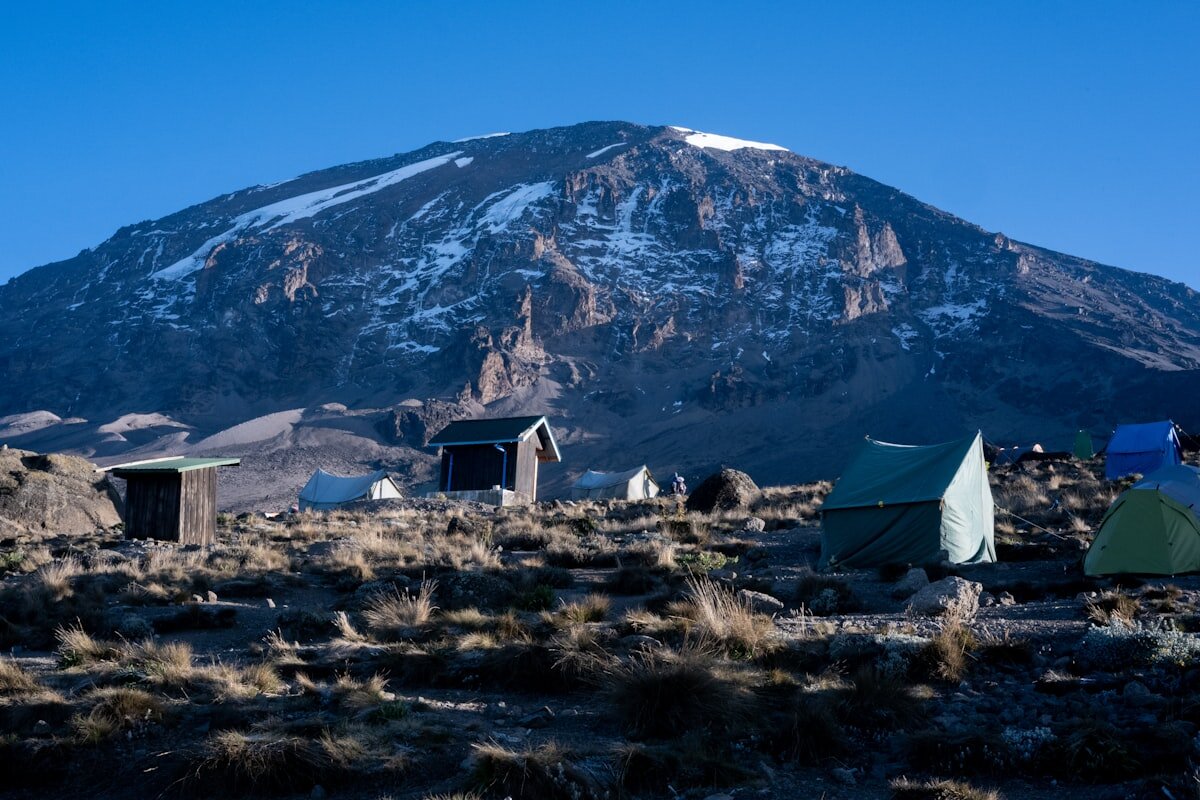
On our routes you sleep in expedition tents at established camps: a roomy two person tent, thick sleeping mats, and a mess tent where meals are served. Our crew sets up and breaks down camp each day. Marangu is the only route on the mountain with hut accommodation, and our packages run the camping routes. Our camp life guide shows what a typical camp looks like.
Every route follows the same daily rhythm, and knowing it in advance takes most of the uncertainty out of the trip. Here is what a day on the mountain actually looks like with KiliPeak.
Morning at camp. You wake to hot tea or coffee, then eat breakfast in the mess tent while the crew packs down camp. By mid morning you are walking, with the day's water, snacks, and rain layer in your daypack. Porters carry everything else ahead of you, so you arrive at the next camp to find it already standing.
Walking hours. Most days are 4 to 7 hours of walking at a deliberately slow pace, the famous pole pole of Kilimanjaro. Your guides set the pace, not you, and the discipline is the point: walking slowly is one of the most effective acclimatization tools available. Short breaks, steady breathing, and plenty of water are the entire technique.
Afternoon at camp. You arrive for a hot lunch, then rest. Some afternoons include a short acclimatization walk when the profile calls for one. Dinner is served in the mess tent, your guides run a health check, and you get a briefing for the next day before turning in early.
Summit night is different. You wake around midnight, eat a light meal, and start the final ascent by headlamp. The climb to the crater rim takes several hours, timed so you arrive near sunrise, and Uhuru Peak follows along the rim. It is the longest and coldest night of the trip, and our lead guides know that night inside out. Our summit night guide describes the whole experience hour by hour.
The honest answers, including the ones that steer you toward patience.
They are different undertakings, and the honest answer is that Kilimanjaro is the bigger physical challenge. The classic Inca Trail trek tops out around 4,200 meters at its highest pass over a handful of days, while Kilimanjaro takes you to 5,895 meters over a week or more of consecutive trekking. Kilimanjaro needs no technical skills at all, but the altitude is serious and the summit night is long. Machu Picchu is a wonderful trek; Kilimanjaro is a high altitude expedition, and you should prepare like one.
Three things we hear after every season. First, hydration and pacing beat fitness: the climbers who struggle most are often the fittest ones who walked too fast. Second, acclimatization days are not padding, they are the product you are buying, and cutting days is the most common reason prepared climbers turn around. Third, summit night is colder and longer than almost anyone expects, and the right layering turns it from miserable into manageable. Internalize those three facts and you start ahead of most climbers.
For any of our packages, plan on 3 to 4 months of sensible preparation: regular hikes with a loaded daypack, stair or hill work, and steady cardio. You do not need to be an athlete; you need to be comfortable on your feet for full days, several days in a row. Our training plan guide lays out a week by week program, and our fitness requirements guide explains what each level should build before arrival. Our how hard is Kilimanjaro guide gives the difficulty question the full honest treatment.
Booking starts a structured preparation process, not the end of one. Every KiliPeak climber follows the same sequence.
Deposit and confirmation. Your 25% deposit secures your dates, and we confirm your package, route, and season in writing. The balance is due 60 days before the climb, and that is the entire payment structure.
The preparation pack. You receive the full gear list, a training plan, and a preparation timeline matched to your exact dates, so every month between booking and departure has a purpose.
Arrival and briefing. We meet you at Kilimanjaro International Airport, take you to your hotel, and run a full briefing and gear check the day before the climb. Anything missing from your kit can be arranged locally, so do not panic about a forgotten item.
The climb and after. Your crew handles every logistics detail on the mountain while you focus on walking and acclimatizing. After the descent you have a hotel night to recover, and every climber who reaches Uhuru Peak receives the official summit certificate.
For the practical timeline of your season, our when to book guide covers how far ahead to reserve dates, and our packing checklist makes the gear side painless.
Contact us and we'll get back to you quickly.